
Curiosity Called the Cops

I love learning. Running out of grant money in college ended five of my favorite years on this planet. After all, my habit would be to sign up for an overload, drop a couple at the deadline, but still sit in if they were interesting (just no homework). Consequently, because of the Army/government grants, I went WAY over the number of college credits needed for graduation.

So as an author, I still have the same passion for learning. Picking a new genre is not good for my brand/business, but for me, I’m just excited to study how to write mystery books. Later this year (hopefully), I’ll be releasing the first in my #mixed-tape-mystery series. While I’ve had the idea for this series for a while, I rolled up my sleeves a couple years ago as I researched the various facets needed for this series. Compared to a “fantasy” series, where it’s all from my own head, a bit of expertise is needed when writing about the real world. So this entry will introduce you to some of the help I received from various experts along the way as I conducted interviews. Some have even agreed to be beta-readers when the manuscripts are finished.

Don Gabler
So I first met Don years ago when his daughter came over to join my kids in the backyard plastic pool. Around that time, I taught Cinema Production, and my Spring of 2002 students had a super ambitious script that involved a school hostage situation. What do these overachievers do? They rounded up both the city police chief AND a real life Blue Earth County Sheriff Deputy to help film this intense scene (we filmed outside of school hours to cause no alarm).
Don worked with fledgling filmmakers and offered some guidelines on how a real officer would operate.
So years later, I contacted him again to just get things rolling. Since my first few books involve Brian Forsberg transitioning from military duty to law enforcement, he shared his own experiences (a couple decades beyond the 1970s setting for my character) and helped share his mindset. He also talked me through the stages of his career with the Blue Earth County Sheriff’s department.
He also helped me find other folks who would offer unique insight, including the next two gentlemen.
Detective Will Purvis

Now, too many authors tell too many stories about detectives, so that’s NOT the kind of series I wanted. I want to showcase the various components to a sheriff department/office. The reason I was so intrigued by Mr. Purvis was the fact that he was nearly the exact same age as my character. His interview focused mostly on motivations to becoming a law officer and the early steps of that journey.
He shared several anecdotes about his early days, including one that’ll be the kickoff for the 5th book in the series.
In the middle of this, we had a bizarre moment. He started talking about one of his early career moments that really shaped him—responding to tragedies. Fifty years after it happened, it was still apparent that these memories were still clear in his mind. That certainly affirmed my idea about my career sheriff reflecting on a career of such moments. The twist came when he gave me just a few details that I recognized from my own family history. Even though I was just a child when this happened, I’d heard enough bits and pieces of this incident to recognize the common details to know it wasn’t just a coincidence.
Yes, Deputy Purvis responded to the tragic accident that took the lives of my Grandpa and Grandpa Guertin. I’ve only experienced the accident through the residual pain carried by my parents and my aunts and uncles, but seeing it from a new perspective really framed it differently for me. What are the odds, right? Just like with Deputy Gabler, I asked Mr. Purvis for some contacts, and he gave me the same name: Paul Barta.
Captain Paul Barta

When I created the fictional resume of Brian Forsberg, I had him returning home to Hiawatha County in 1972, taking his classes in 72-73, getting his first jobs from 74-76, finding a home with the HCSD in 1977, and then in 1980, getting a nudge to run for Sheriff. So my 5th story/book was going to be about his experience running for office, and as it turned out, the year Purvis and Gabler mentioned Paul Barta as a contact, guess who was running for sheriff?
So that summer, I got to meet Captain Barta on a few different occasions. The first time, I happened to have a booth at the Blue Earth County Fair, and guess who was also there campaigning? Since I was trapped at my booth, he found time to come over and we had a great talk. This conversation really centered around his own resume and how he decided to run for office. With two decades of experience, he certainly had more tangibles than my character.
Later that summer, he was “working the county,” so he found time to swing by my house while on the campaign trail in Mapleton. So this time, we sat on my front porch and he really gave me some great insight into the emotional toll the campaign had. Since my series is going to be designed to show the “WHOLE TEAM” at a sheriff's department, Barta’s insight into the process was fascinating, especially the concept of running against someone from your own team.
The race?
While I was personally pulling for “my guy” to win and become sheriff (that would’ve been helpful for books after #5), the other guy—Jeff Wersal—ended up winning a fairly close race. Having talked to several Blue Earth County residents, I learned that Jeff Wersal had the “good old boy” thing going for him and his personal connections with the community seemed to resonate. Noted. So I’ve been leaning into building those connections for my own “good old boy” from Split Rock running against candidates with much better resumes.
With the first book focusing on the metaphoric “Scourging of the Shire” for Forsberg, the second book shows him getting any kind of job he could. In this case, he gets seasonally employed by the Crow Wing County Sheriff’s Department Water Patrol Unit. So I emailed Captain Barta, and he sent me down the next rabbit hole.
Tom Coulter

Mr. Coulter really helped me understand the parameters of what happens with Water Patrol. He’d begun his career in the 1990s as a Washington County Water Patrol Intern before coming to Blue Earth County as a deputy. With so much experience, I was able to ask him about duties of the position, pros and cons of the position, the challenges of working lakes and rivers, and some of the typical situations he faced in this role.
This talk really helped me understand where this “job” could take my character and the types of crimes and situations he’d be facing. After an hour of talking, I finished the conversation by asking the next logical step: Do you know anybody that worked water patrol in the Brainerd Area? He had names!
Rittgers and Collette

Despite being a bit “too young” for my character, Lt. Rittgers was a great interview. He was able to reinforce so many of the same details I heard from Tom Coulter and ideas began to take shape. He really painted a picture of the day-to-day operations of a water patrol officer.
If you’re not familiar with the Brainerd Lakes region (Cass and Crow Wing Counties), we’re not just talking about a thousand lakes but we’re also talking about several river systems as well. So he was a great contact.
About the same time, he also connected me to a current water patrol officer from Cass County, Deputy Travis Collette.
Both of these gentlemen provided me with very specific ideas and details about how things ran in the region and the conversation also grew a bit darker as they discussed the realities of drownings and recoveries.
During our conversations, I was also able to learn seasonal shifts in duties and how they often work with other departments, such as the DNR. When I mentioned that my story was going to be set on Gull Lake, (I believe) Deputy Collette dropped another name that turned out to be the perfect contact for my situation.
Neal Gaalswyk

This guy really knew Gull Lake, and he should! After all, he worked for Cass County for most of his career with the unique responsibility of patrolling the largest lake in the region. So he was able to talk about the chain of lakes, the ways water patrol changed from the 80s to the 2010s, and just the basic cycles of the position. With book two being called On the Border, he also gave me good insight into how the county line affected jurisdiction on the lake.
It turns out there are two different philosophies about water patrol between the two counties. For Crow Wing County, they see water patrol as a good position for younger officers to gain experience; conversely, Cass County likes to have veteran officers like Gaalswyk learn and master their craft, providing a steady voice in volatile situations. Gaalswyk noted that the position is very important PR for the county, and thus, he’s seen several members of water patrol go on to become sheriffs at various counties.
In passing, his anecdotes about Gull Lake really came to life in my imagination and I was able to use the unique geography and landmarks as plot points in the book. He explained how different areas of the lake had different vibes, and how the locals would often be allies in dealing with the weekenders who caused problems. Like the other guys in water patrol, he also mentioned the dread of drownings, which pushed him to be vigilant in his patrols. Having responded to drowning victims ranging from 2 to 84, the emotional toll could certainly be felt over the phone. He also discussed crimes, such as theft from boats, which helped me understand the range of investigations.
On a personal note, one of my high school friends was a Gaalswyk, and as soon as I looked up Mr. Gaalswyk, who is a county commissioner now, I couldn’t believe the strong resemblance. So when I created a fictional version of Mr. Gaalswyk, I began to picture my former classmate in the chapters.
Malloree McCarthy
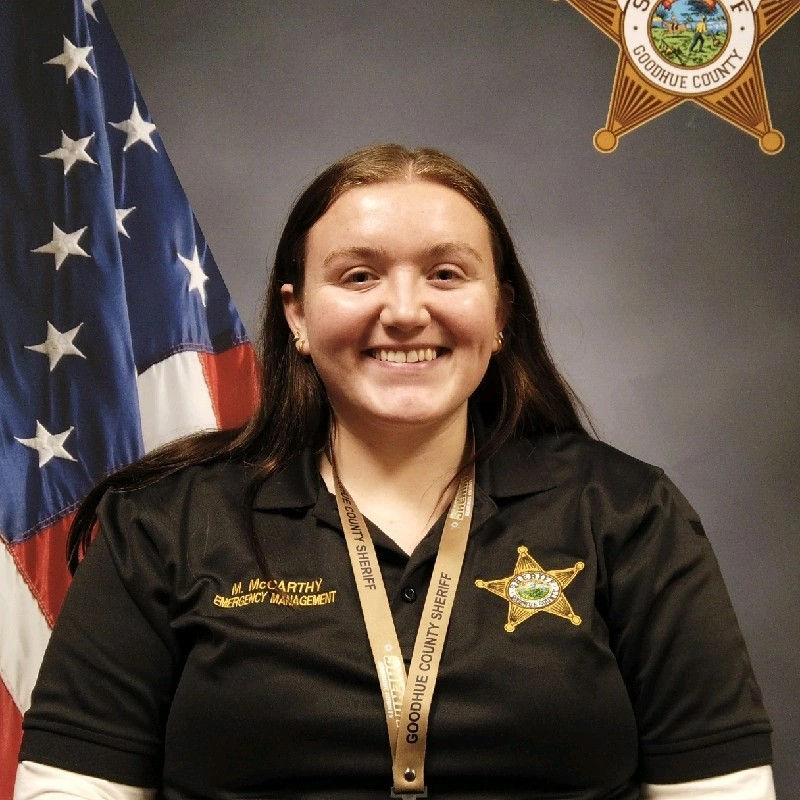
In trying to bring Hiawatha County Sheriff’s Department to life, I studied the structure of several departments and how they were staffed. While I’m a few years away from my character moving up the ladder, I’m nevertheless brainstorming ideas. One idea involves his trusted right-hand man, Ron Spears. In book one, Spears and Forsberg meet in a law enforcement class and become friends, but as fate has it, they both go their separate ways. When Forsberg does become sheriff, he brings in guys he can trust, such as Spears.
Ron Spears will be the Emergency Management Director, and as it so happens, one of my former students had just started a similar position in Goodhue County.
So after meeting briefly at a book-signing event in Red Wing, Malloree and I scheduled a zoom meeting and she just explained all about what she’s doing and what her boss does in the role of Emergency Management Director. The more I listened, the more I realized this department needs to be ready when “the sh@t hits the fan.” She explained all the training and rehearsal needed for various situations faced by a county. Given the unique nature of Goodhue County, she even mentioned the need to be prepared for issues for the nuclear power plant at Prairie Island.
Unfortunately, I won’t be using/needing these ideas for a few more books, but I can tell already that Malloree and I might have some long talks once I play God and bring mayhem and destruction to Hiawatha County.
FBI Section Chief Jason Fickett

No, I’m not going to write a series about an FBI agent, but my “Greek Chorus” character Cassie Campbell is investigating her uncle’s life in the present day as she begins rehabilitating career-ending injuries suffered while on duty with the FBI.
As it turns out, one of my teaching colleagues at Maple River not only joined the FBI, but kinda went all the way to the top. For all I know, he’s monitoring my internet history right now. He’s had quite a career, you see. While we both attended MSU at the same time, we first met in 1995 when I was a student teacher, and over the next few years, we saw a lot of each other. I remember when we arrived early (we were carpooling?) to school only to find it vandalized. No school that day, but I remember how personally he took it. A few years later when 9/11 happened, he again took it personally and ended up transitioning from teaching to the FBI. In 2002, he handed off his role as NHS adviser to go chase bad guys. The veteran teachers on staff would share updates about what Special Agent Fickett was up to. Did you hear he’s on the FBI Swat team? He’s in Afghanistan now. No, wait, now he’s in Rome. Guess what? He’s gone into the Cyber Task Force now. Oh wait, now he’s in Washington DC.
Fickett’s story is worthy of its own novel, but I really only needed his help to understand his early days in the FBI. We’ve been in touch through the years, so all it took was a Facebook message to schedule a conversation. So Cassie Campbell’s career will mirror Fickett’s so that I can get some unique details for her character. Like Fickett, she sees 9/11 open the narrow door a bit wider to someone typically too young wanting to become an FBI agent.
So my conversation with Fickett mostly focused on the application process and early training of becoming an FBI agent. Since the reader is slowly getting to know Cassie, many of these anecdotes about training will be sprinkled into her story over the first few books. (She’s a mystery unto herself). With her home in Hiawatha County having a connection to the Anishinaabe’s Seventh Stopping Place, it was a convenient coincidence that Fickett was stationed in Buffalo, where Niagara Falls happens to be the Second Stopping Place. So in the coming books, I’ll likely return to Fickett for more details about Buffalo specifically.
So those are my "technical supervisors" that I went to with questions. Sometimes the journey is as fun as the destination.


Comments